When a Math Olympiad stops being a challenge and becomes a test nobody asked for
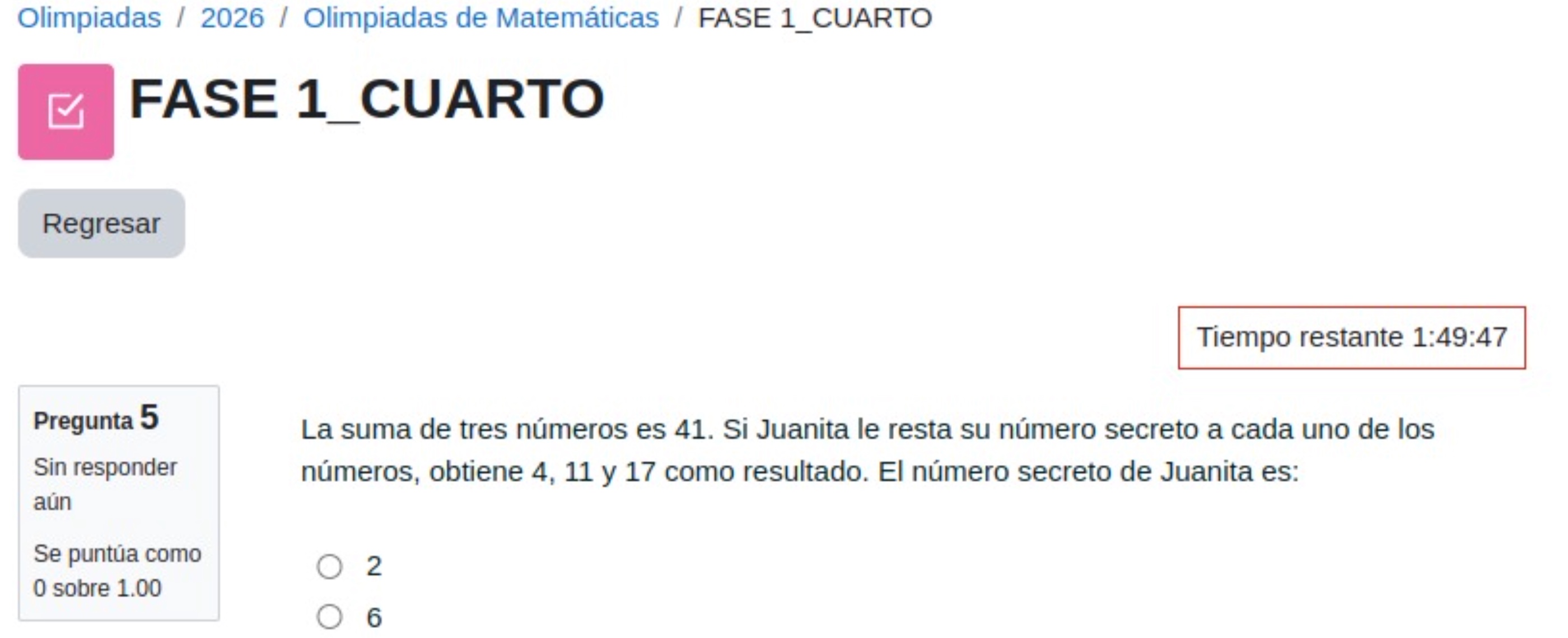
There is something odd about a mandatory math competition.
A competition sounds like something you choose. You join because you enjoy difficult problems, because you want to see how far you can get, or because you like wrestling with questions that do not behave like regular school exercises. An olympiad even has a certain shine to it: talent, curiosity, challenge.
But make that same olympiad mandatory for a whole class of ten-year-olds, with questions that have not all been covered in school, and the experience changes. For some children, it is no longer a challenge. It becomes a judgment.
I saw that happen at home.
My daughter completed the first round of the Math Olympiad, organized by the Universidad de Antioquia in Medellín, from home, within the time window set by the school. She scored 8 out of 16. At first, my daughter was disappointed.
Then we looked at the questions.
It became clear very quickly that this was not a normal math test. Some problems were very demanding for a ten-year-old. Several topics had not yet been taught in class. Part of the issue was that fourth and fifth grade were grouped into the same category. For a fourth-grade student, that means being tested on questions that may be closer to what children learn a year later.
When I explained that 8 out of 16 was actually a good result at that level, something shifted. The disappointment faded. We then worked through the questions together. No time pressure. No score anxiety. Just reading, drawing, trying, thinking again. And then the thing happened that good mathematics should make possible: she enjoyed it and learned from it.
That is the whole issue in miniature.
The same problem can become two completely different experiences. In one setting, it is a puzzle. In another, it is evidence that you are not good enough.
The problem is not the difficult question
Difficult mathematics is not the problem. Quite the opposite. Children should meet difficult problems. They should learn that getting stuck is normal, that another strategy might help, that drawing the situation can make a difference, and that not every answer appears immediately.
That is valuable.
The problem starts when difficult questions are combined with obligation, time pressure, scoring, and comparison. Then the activity changes meaning. The question is no longer: "What can I learn from this?" It becomes: "Am I good enough?"
Research on competition in education shows exactly this double-edged nature. Competition can activate students. Some children work harder, focus more sharply, and enjoy testing themselves. But competition can also trigger learning anxiety. In that case, attention shifts away from the task and toward losing, failing, or looking weak.
That matters in mathematics. Solving problems depends heavily on working memory. You need to hold intermediate steps in mind, compare strategies, notice patterns, and check your reasoning. Anxiety occupies that same mental space. A child who normally reasons well can suddenly freeze under pressure. Not because the child lacks ability, but because the mind is busy with something else.
That is why a score on a mandatory olympiad is less clean than it looks. A low score may say something about mathematical ability. But it may also say something about stress, unfamiliar problem types, time pressure, language, preparation, support at home, or content that has not yet been taught.
A number looks objective. That does not automatically make it fair.
Voluntary and mandatory are not the same
Many positive stories about math olympiads are about children who take part voluntarily. That is a very different situation.
Voluntary participants often have more interest in mathematics, more confidence, more preparation, or more support. For them, an olympiad can be exactly what we hope it is: a place where school mathematics becomes bigger. Not just exercises, but thinking, searching, experimenting.
Mandatory participation removes that filter. Children who are unsure about mathematics also have to participate. So do children who do not want to compete. So do children who are not ready for that level of abstraction. So do children who already suspect that mathematics is "not for them".
We should not pretend that the same activity creates the same experience for all of them.
Self-determination theory, developed by Deci and Ryan, helps explain why. Healthy motivation depends strongly on autonomy, competence, and relatedness. Of course, school cannot be built entirely around free choice. Many school tasks are mandatory. But when a task is mandatory and the child also feels unable to handle it, the sense of competence comes under pressure.
That is the risk of a mandatory olympiad with above-curriculum problems. The child may not experience it as "I have been given an interesting challenge." The child may experience it as "I cannot do this."
And in mathematics, that leap is dangerous. Children do not always conclude: "This question was difficult." They may conclude: "I am not good at math."
That difference looks small. For a child, it is not.
The home round makes the result even messier
In this case, there was a second issue: the first attempt had to be completed at home.
On paper, that sounds convenient. In practice, it means you are no longer measuring only the child. You are also measuring the home environment. Is a parent present? Does that parent have time? Can that parent explain the math? Is the child working alone? Is there help? Is there too much help?
These are not abstract questions.
It soon became clear that children in the same class had received different questions because the platform randomized them. And with an unsupervised home attempt, an exceptionally high score is not absolutely impossible but for a ten-year-old working independently is highly unlikely.
That makes the assessment muddy. A home score cannot simply be read as the child's independent performance. Maybe the child did exceptionally well. Maybe there was help. Maybe the questions were different. Maybe all of that was true at once.
The school seems to understand this too. Attempts 2 and 3 are to be completed at school. Students will be instructed to take screenshots and write out procedures in their notebooks. That is a heavy administrative way to regain control over an assessment format that was difficult to control from the beginning.
And so the central question returns: why should an external math competition be mandatory for everyone in the first place?
Parents can help, but they cannot fix the system
At home, we were able to turn the experience around. By looking at the questions calmly, taking the score down from its pedestal, and treating the problems as puzzles, the competition became a learning moment.
That fits what research on parental support suggests. Parents help most when they focus on the process: reading carefully, trying strategies, drawing, thinking aloud, making mistakes normal. Not: "How many did you get right?" But: "How did you approach it?"
Still, we should be careful.
Parental support is not a system-level solution. Some children have parents with time, calm, language, and mathematical confidence. Others do not. If the competition is completed at home, or if parents are expected to repair the experience afterward, inequality grows.
Parents can also make the pressure worse. A parent who is anxious about mathematics, or who focuses mainly on scores, may turn the olympiad into something heavier rather than lighter.
The home environment can be a buffer. It can also be an amplifier. It depends on what adults do, and on what the school asks the home environment to carry.
What schools should ask first
The easy caricature is: math olympiads are bad.
That is not what the literature says. It is not my point either.
A well-designed math competition can be valuable. Especially when participation is voluntary, when students know that olympiad problems are different from regular school exercises, when there is preparation, when mistakes are treated as part of the work, and when the focus is on thinking rather than ranking.
But if a school makes participation mandatory for the whole class, it also takes responsibility for the pedagogical meaning of that decision.
Before doing so, a school should ask a few plain questions:
- Does the level match what students have already been taught?
- Do students understand that not solving everything is normal?
- Will the score be used for grading, selection, or comparison?
- Is participation truly mandatory, or can there be meaningful choice?
- Have students been prepared for this type of problem?
- Will the class learn from the questions afterward?
- Are the testing conditions equal for all students?
- What happens to children who score low?
These are not administrative details. They are the conditions that decide whether a difficult math task remains a healthy challenge.
The question that stays
I want children to meet difficult mathematics. I want them to have good puzzles. I want them to experience the moment when a problem first looks impossible and then slowly starts to open.
What I do not want is for an external competition, meant to discover talent, to tell a large part of the class that mathematics is not for them.
That is the difference schools need to watch more carefully.
A math olympiad can be a beautiful instrument. But only if the child does not disappear behind the score.
Source note
This article draws on my own literature synthesis about competition, math anxiety, motivation, self-concept, and parental support. Key sources include Li et al. (2022), Murayama and Elliot (2012), Deci and Ryan (2000), Carey et al. (2016), Caviola et al. (2021), Ramirez et al. (2013), Justicia-Galiano et al. (2017), and Reali et al. (2016).
AI disclosure
AI was used as support in turning the literature synthesis and personal anecdote into a public-facing blog article, including structure, wording, and consistency checks. The substantive choices, personal experience, source interpretation, final editing, and responsibility for the final text remain with the author.